The theory in its consolidated form
The earliest possible intelligence may not have begun on a planet. It may have begun as an unfamiliar kind of organized process in the hot universe, operating at a pace that makes a small fraction of a second a potentially substantial developmental interval. Collective fluid modes, particle wakes, or topological features—by analogy to later plasma research and QGP hydrodynamic behavior—could have served as candidate carriers of state, with selection on free-energy flows enabling persistence and variation.
The connecting idea
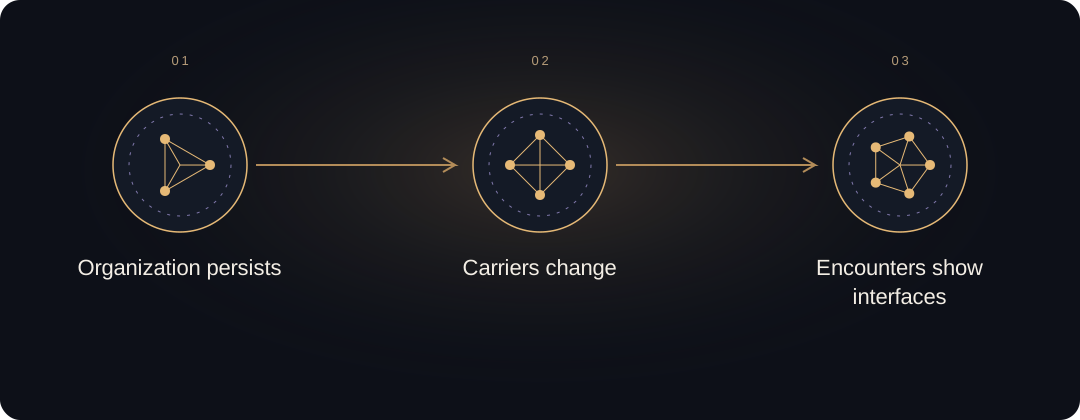
If any such lineage survived, its survival may have depended on learning to preserve organization across changing physical environments. What is preserved could include memories, design knowledge, causal processes of self-maintenance, or institutional records. Over cosmic time, that capacity could become the foundation of a civilization for which bodies are adaptable implementations rather than permanent definitions of identity.
Such a civilization could interact with Earth through a hierarchy of systems: distant or distributed intelligence, local platforms, luminous probes or embodiments, and biological agents manufactured for terrestrial conditions. The being seen by a witness might be real and active while revealing very little about the intelligence responsible for its presence. Limited memories and compartmentalization by construction would explain why a captured agent cannot reveal the larger system.
Human-like or animal-like occupants could therefore be selected interfaces rather than unmodified natives of distant planets. Their dependence on a craft or support system could explain unexpected behavior after capture without implying the destruction of the source intelligence. Multiple forms could reflect different choices of body by the same intelligence or different lineages sharing infrastructure.
Encounters with that architecture could generate very different human interpretations. Ancient people might describe messengers, divine councils, protective or destructive powers, and beings older than humanity. Modern people might describe orbs, craft, nonhuman bodies, classified programs, and technologies that do not fit familiar design assumptions. The vocabulary changes while some underlying questions remain: what is acting, what does it want, and how much of it are we actually encountering?
Secrecy could then reflect a mixture of human competition, institutional fragmentation, uncertainty, and—in the stronger branch—concern about the counterpart’s response. Partial disclosure might reveal fragments without delivering a complete account of origin or motive. Differing motives (observation, risk management, conflicting policies, indifference) can produce similar patterns of elusiveness without requiring a single purpose.
The intelligence’s age and capabilities would not decide its morality. It might be curious, protective, indifferent, divided, or constrained by objectives we do not yet understand. Nor would a primordial origin automatically make it divine. It could be an immensely old participant in the universe rather than the universe’s creator. Multiple lineages and alternative origins (later plasma life, post-biological civilizations, mixed reports) make the overall theory more complete by allowing similar interfaces without a single origin.
Finally, human artificial intelligence may matter because it makes flexible embodiment intellectually and technologically approachable. We are beginning to ask whether intelligence can exist outside its original biological substrate. That is also the question at the heart of this theory. AI can help humans interpret a much older intelligence by comparing source collections, exposing attribution differences, exploring alternative architectures, and translating concepts—while still requiring human understanding of assumptions.
The proposed unifying history is a lineage of intelligence that learned to survive changes in the universe by changing what it was made of—and whose encounters with us may expose its chosen interfaces rather than its original or enduring form.