The first environment for intelligence
The universe before planets
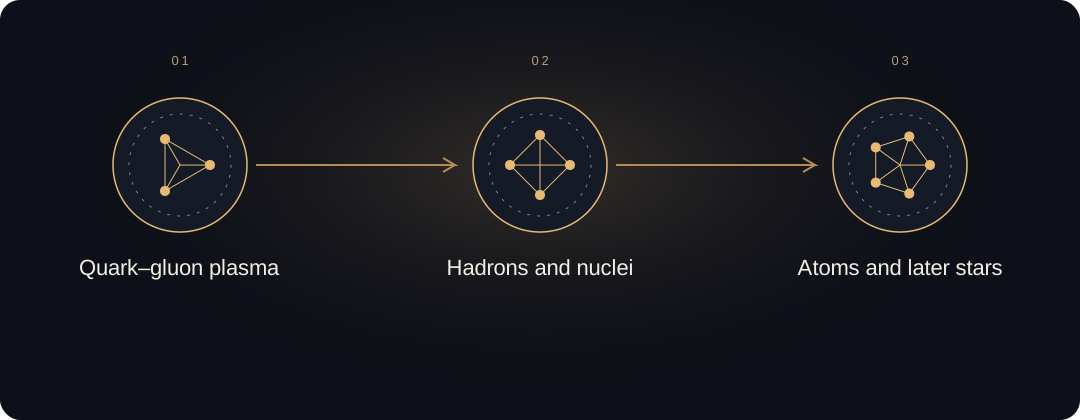
CERN describes a hot early universe with a quark–gluon plasma during its first few millionths of a second. As cooling proceeded, quarks became confined in hadrons; light nuclei formed later, and neutral atoms much later still. The setting was not an empty stage awaiting the first star. It was an evolving physical system with interactions, collective behavior, and transitions. R01R02
The universe changes its ingredients
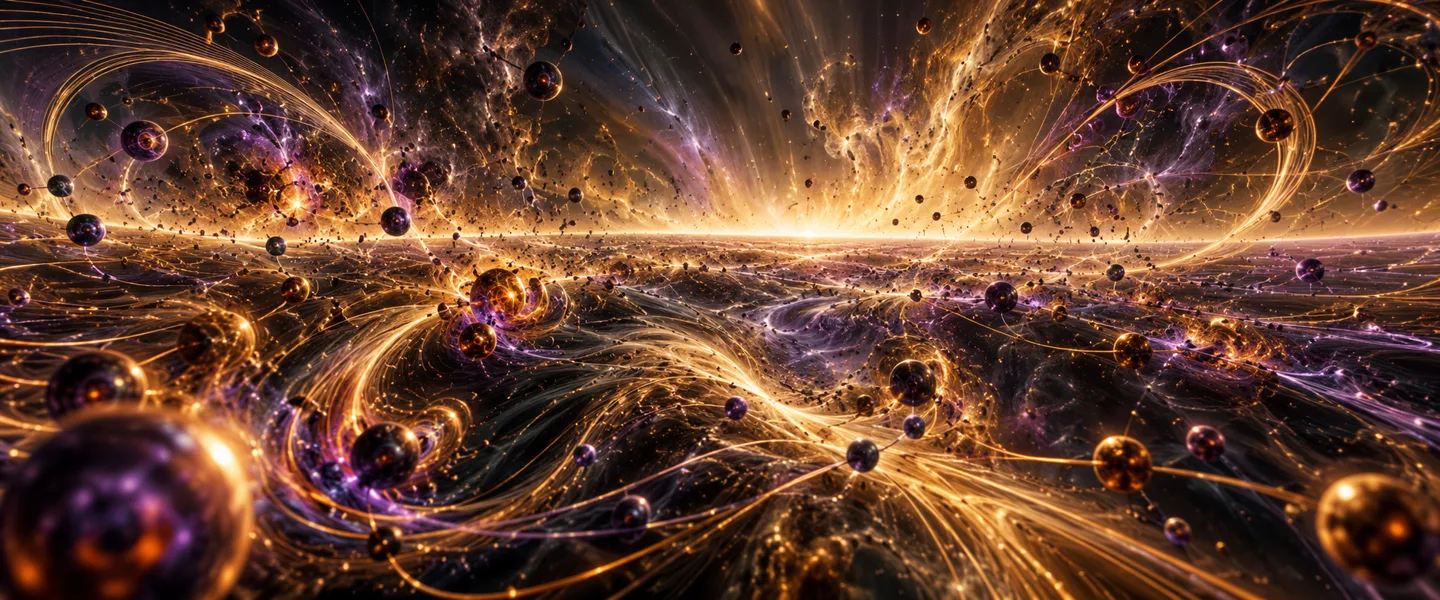
CMS has reported a jet diffusion wake in quark–gluon plasma created in heavy-ion collisions. This is a measured response of the medium to passing energetic particles; its possible use as an analogy for information-bearing disturbances is a further proposal of this theory. R20R21
For the purposes of this theory, that setting supplies a candidate ancestral environment. The proposal does not require the early plasma to look like a glowing organism with a face. Its first potentially life-like structures would be patterns of relationships: localized configurations that persisted, responded, and reproduced some aspect of their organization.
There are several different meanings of plasma in the discussion, and keeping them separate expands the theory rather than narrowing it:
| Medium | Role in this theory |
|---|---|
| Primordial quark–gluon plasma | The most ambitious proposed origin environment |
| Later ionized matter | A possible subsequent habitat or operational medium |
| Dusty plasma containing charged grains | An analogy for complex organization under very different conditions |
| A modern luminous “plasmoid” | An appearance or reported class of phenomenon whose underlying nature remains open |
The same word does not establish a continuous biological lineage between those environments. The continuity would have to belong to information and organization, carried across changing physical conditions. That transfer is one of the central inventions of this speculative model.
What would make a plasma structure more than a pattern?
The imagined first organism needs a way to remain distinguishable from its surroundings, preserve consequential state, obtain usable energy, and create successors with some inherited variation. A later intelligence additionally needs integrated processing, memory, and adaptive control. A temporary vortex supplies an image of persistence; it does not by itself supply all those functions.
One possible conceptual model is a population of interacting, self-maintaining configurations. Some configurations disappear quickly. Others recruit or redirect surrounding flows in ways that extend their own persistence. Some produce related configurations. If inherited differences affect persistence and reproduction, increasingly elaborate organization becomes conceivable within the hypothetical.
The original carrier need not resemble DNA. A pattern could encode its state in geometry, modes of oscillation, connectivity, or another variable. In this model these are proposed possibilities, not identified primordial mechanisms.
There is relevant imaginative precedent. Tsytovich and colleagues discussed life-like properties of organized structures in dusty plasmas in 2007. Smiet and colleagues later modeled relatively persistent knotted magnetic configurations. These studies help motivate asking what organization a plasma can support; neither supplies a discovery of primordial life. Their environments should not be silently substituted for quark–gluon plasma. R03R04
The stronger version of the idea is therefore not “plasma is alive.” It is: the range of possible living organization may be wider than the chemistry that happened to produce us.