Organization, information, and time in a hot medium
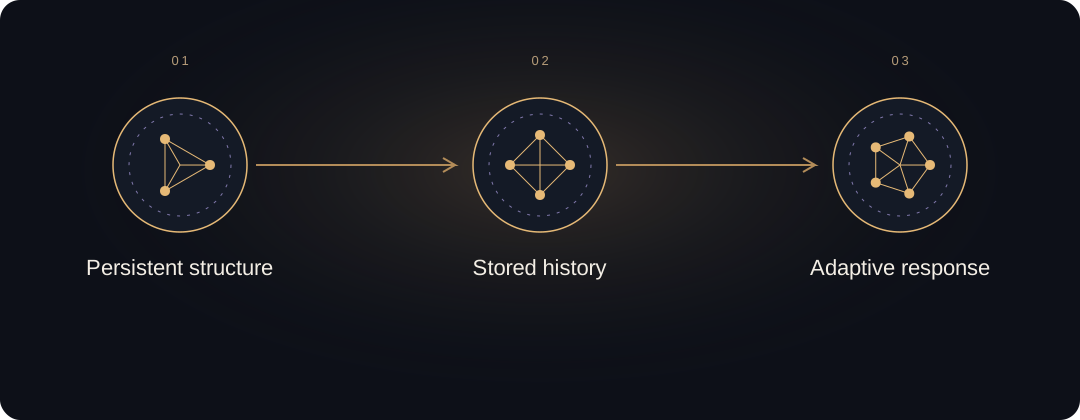
The first question is how a fleeting arrangement could acquire a history that affects what it does next. A hypothetical organism must couple persistence to action: retain a state, respond differently because of it, and influence the conditions under which that state continues.
From activity to organization
Grok's second pass proposed several candidate ways to imagine that organization. They are alternatives within the speculative model, not a single established mechanism.
Collective disturbances as state
A wake or oscillatory mode could be imagined as a temporary record of an interaction. A coupled system might respond to the sequence of disturbances rather than only to its immediate surroundings. The CMS result supplies a concrete example of a medium's response to an energetic particle. It does not demonstrate a writable memory, organism, or conscious process. The additional proposal is that some other configuration could repeatedly produce, retain, and respond to such states. R20
Geometry and connectivity as memory
Another possibility is that information resides in how a configuration is connected, rather than in a particular set of particles. Smiet and colleagues simulated quasi-stable linked and knotted magnetic structures. That motivates a question about persistence, without establishing an error-proof memory or a primordial mechanism. R04
The more adventurous extension would be structures involving color flux in the early medium. That is a separate conjecture; ordinary magnetic knots cannot simply be renamed as quark–gluon organisms.
Boundaries maintained by interactions
Grok also proposed borrowing the idea of effective attraction and screening from dusty-plasma discussions to imagine self-maintaining boundaries in a different medium. The useful question is whether a system could continually renew a distinction between itself and its surroundings. The charged grains in the dusty-plasma analogy are not present in the same form in primordial quark–gluon plasma. A grain-free version would need its own proposed mechanism. R03
Inheritance, repair, and coordinated control
Suppose some configurations produce successors that resemble them. If differences in their organization affect survival or reproduction, selection could accumulate useful structure. Selection alone is not error correction: active repair would additionally require a way to detect a damaged state, retain redundancy, or reconstruct a working arrangement. These are distinct proposed functions.
The imagined next step is coordination. Local responses become linked into larger feedback systems, and some states begin to represent environmental trends. A population might then progress from merely persisting to anticipating conditions, changing its surroundings, and constructing successors deliberately.
This proposal makes the relevant processing interval the time needed for a useful coordinated operation, not simply the shortest particle interaction. Whether such an architecture could exist is left open. Within the story, its emergence is what converts rapid physical activity into a potentially meaningful developmental history.
A proposed transfer sequence
The survival problem can be made more concrete without pretending it has been solved. An intelligence might first encode the same useful state in two interacting structures, then use overlap between them to keep behavior coordinated while one carrier becomes less viable. A recipient structure would gradually take over functions until the old carrier was no longer required.
This is a speculative migration sequence: duplicate, couple, compare, transfer, and release. A different route would preserve a dormant record for reconstruction later. The first offers continuity of activity; the second offers continuity of recoverable information. Neither alone settles whether the same subject of experience survives. That distinction becomes important again when the theory reaches biological avatars.