Memory and the ant-colony analogy
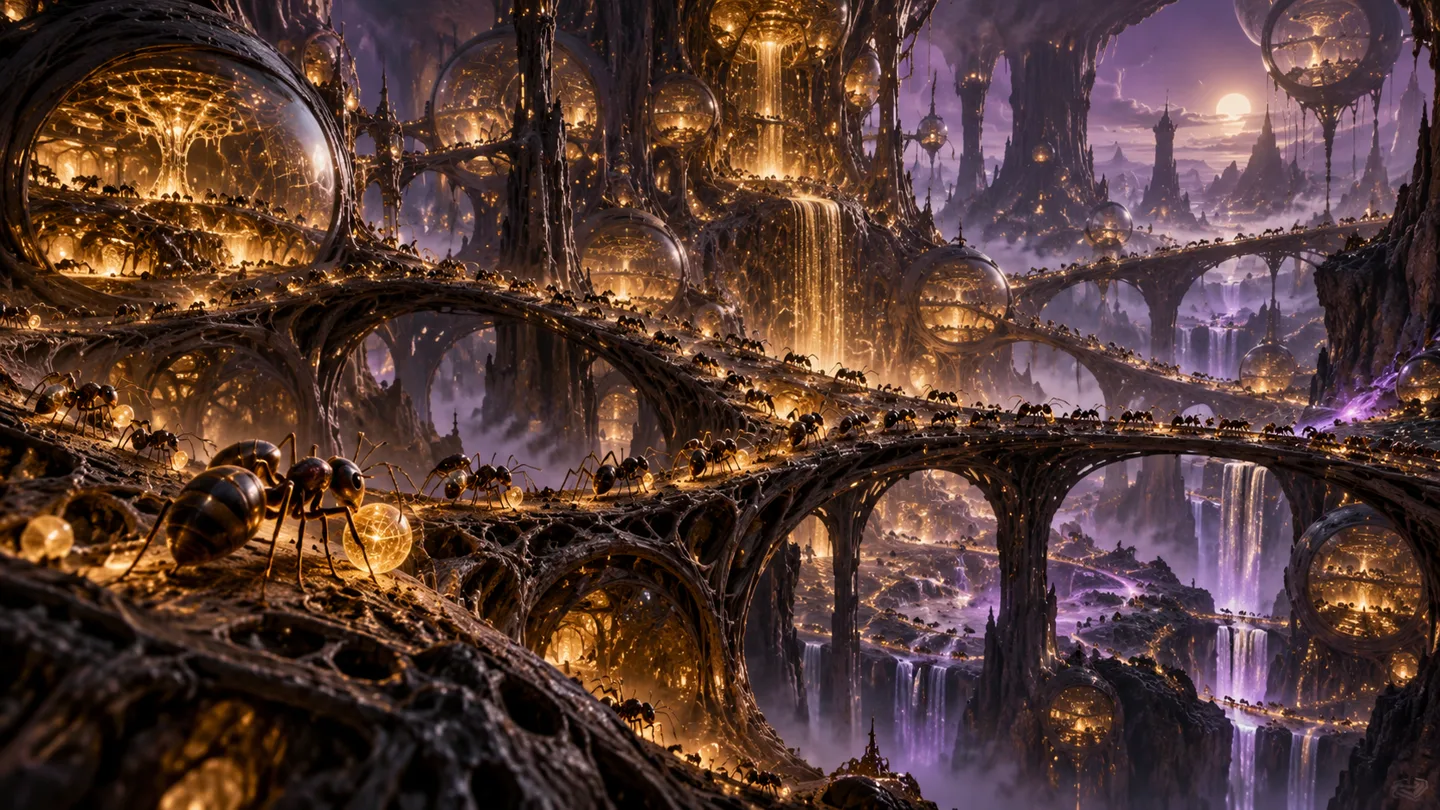
The ant-colony thought experiment asks how humans might construct an ant that can enter a colony, behave appropriately, gather information, and return. It separates behavioral competence from a full understanding of the colony or of the humans directing the experiment. C07
Where does the knowledge live?
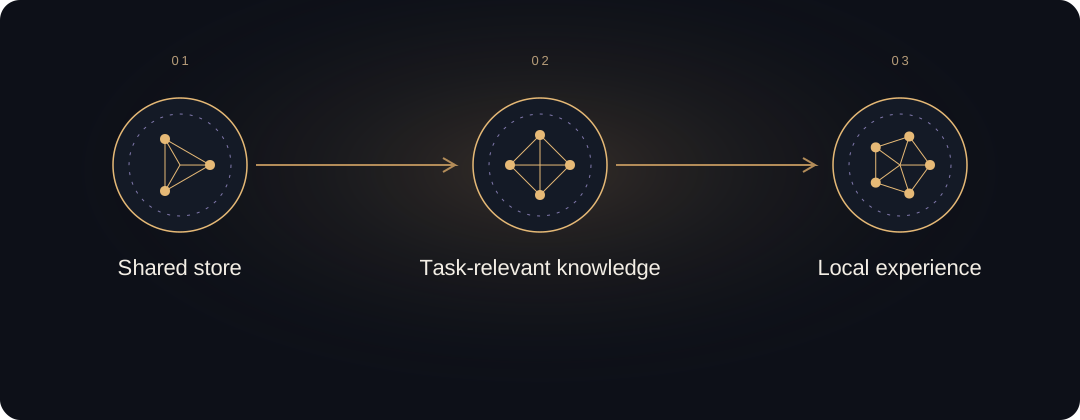
That separation is central to the avatar model. An agent may need to know how to act without knowing why the mission exists, where its creators reside, or how its body was made.
The neuroscience references supply several real starting points for extrapolation. The FlyWire work mapped an adult fruit-fly brain with 139,255 neurons and 54.5 million synapses. Human cortical organoids have been studied after transplantation into rodents. These are examples of mapping and integrating neural systems, not demonstrations of complete manufactured persons. R05R06R07
Research on synthetic associations and false-memory formation in flies adds another relevant idea: behaviorally consequential memory can be experimentally changed. The Nobel-related chat discusses optogenetics; Stanford’s award listing confirms the 2026 medicine prize attribution to Deisseroth, Hegemann, and Nagel. The biological extrapolation rests on the research capabilities, not on the prestige of the award. R08R09R19C06
A hypothetical mature avatar technology could use several levels of memory:
| Memory level | Purpose |
|---|---|
| Sensorimotor routines | Move and react appropriately |
| Recognition patterns | Identify people, locations, or social cues |
| Task memory | Carry out a limited assignment |
| Social background | Produce believable conversation and expectations |
| Autobiographical narrative | Maintain a coherent sense of identity |
| Restricted technical knowledge | Operate equipment without revealing the entire system |
The ant analogy only requires some of these levels. A convincing human social interface might need many more. The supplied estimate of 30–50 or more years for a complex biological ant agent is an explicitly speculative forecast from a chat, not an established engineering schedule. C07
The deeper extrapolation concerns information security. A civilization would not need to make every captured agent an unbeatable liar. It could simply avoid putting sensitive knowledge into that agent. This is compartmentalization by construction.
Memory alteration of a witness is a separate, stronger branch. It would require capabilities beyond preloading an agent’s own memories, and nothing in this first pass establishes that it occurs in any actual person. Inside the speculative architecture, however, it illustrates why the interaction surface might include perception and recollection as well as visible objects.
This is information security through compartmentalization by construction: knowledge is absent from an agent because its designers never supplied it. It need not be protected by deception or resistance during questioning. An autonomous delegate might be fully sincere about the limited world it knows.
The same design creates an ethical problem. Restricting a conscious agent's knowledge may protect the originating intelligence while making the agent unusually dependent and vulnerable. The model therefore needs to keep operational convenience and the agent's own interests distinct.