Why contact might remain indirect
The source discussion repeatedly asks why something so capable would remain elusive. The theory allows strategic choice without making it a universal explanation for missing information. C02D01 (paragraphs 7, 12, 28)

Routes to indirect contact
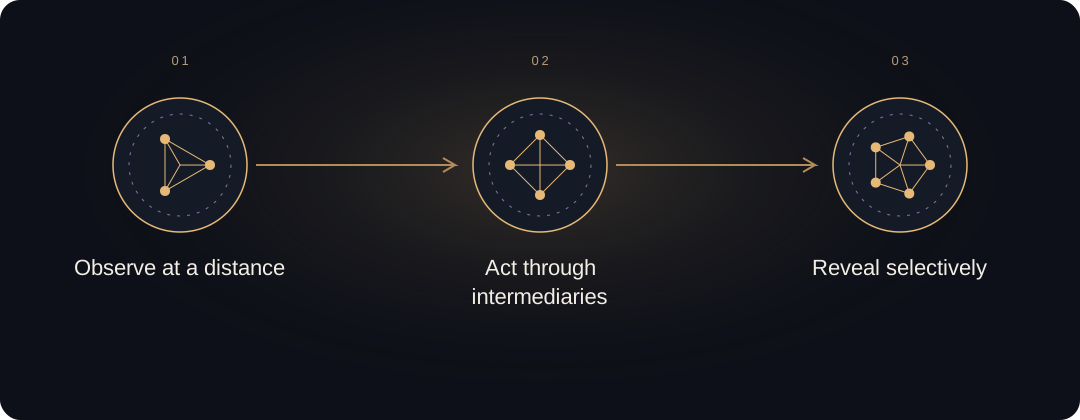
Possible motives include:
Low-interference observation. Overt contact changes what is being studied. A civilization interested in independent cultural development might prefer indirect observation. What it learns: developmental trajectories without the observer effect of announcement.
Different priorities. The atmosphere, oceans, biosphere, or local physical environment may matter more than human politics. Activity could intersect with us without being primarily addressed to us.
Limited delegated missions. Local agents may be authorized to perform tasks but not to negotiate with governments or explain their origin. Disclosure would exceed their compartment.
Risk management. Contact could be hazardous to either side through physical interaction, cultural disruption, misunderstanding, or disclosure to rival groups. A visible body might be used for specific tasks that require presence, while the bulk of activity remains non-visible.
Conflicting policies. Different factions might disagree about contact. Some encounters could be deliberate while others result from operational errors or unauthorized activity.
Gradual familiarization. A group might prefer partial, culturally absorbable encounters to a single public announcement. This is one possible reading of recurring stories, not a demonstrated historical program.
Indifference. Public recognition by humanity is not a relevant objective.
These motives can generate different patterns. Low-interference observers should behave differently from missionaries, collectors, territorial actors, or curious individuals. A later pass can explore those differences instead of treating every possibility as interchangeable.
Selective contact creates a practical puzzle for human institutions. An encounter may be important to the participant yet leave little that can be shared with others. Institutions then argue over records, interpretations, access, and standards of confidence. Those disagreements could persist even when participants are sincere.
This does not mean that disagreement or silence proves manipulation. It means that an intelligent counterpart would be an active participant in the encounter, not merely a passive object waiting to be measured.