Encounters and the problem of retaliation
The supplied discussion treats Stratton’s reported family experiences as a possible reason for fear among investigators. The linked retaliation chat is visibly incomplete: it begins answering and then stops. Its missing continuation cannot be reconstructed as if it had been read. C08

An encounter inside a larger system
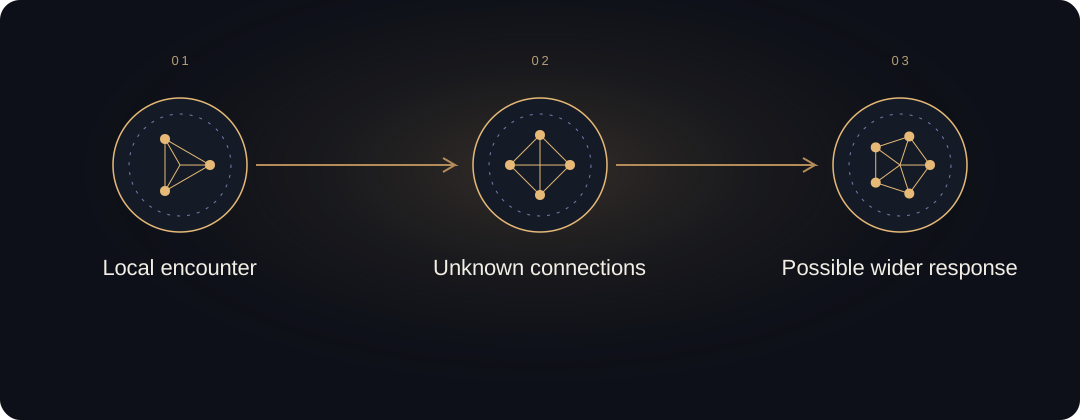
The second NewsNation compilation supplies a fuller direct account. Stratton describes seeing a humanoid-looking figure at his son’s window, gives its facial features, recounts pursuing it outside, and says it was gone. He also discusses earlier encounters with taller figures. V03 (14:30–16:25)
Within the theory, that account suggests a reversal of the observer relationship: an investigator who thinks he is studying an unknown phenomenon may come to believe that it has become aware of him.
Several interpretations remain possible even while granting the encounter hypothetically:
- Surveillance of an investigator.
- Curiosity about a household associated with the investigation.
- A demonstration of access intended as a warning.
- An encounter unrelated to the investigation but interpreted through it.
- An interaction whose purpose does not fit familiar human categories.
“Retaliation” is therefore a proposed motive, not simply a synonym for a disturbing encounter. Timing, recurrence, communication, and a demonstrated connection to investigative activity would matter to that interpretation.
The theory can incorporate the possibility of coercion without asserting that every frightening experience has that cause. Nor should it turn the hypothetical into a claim that the reader, researcher, or their family is being watched or threatened.
At the civilizational level, uncertainty itself could influence behavior. Officials might hesitate because they believe an intelligence can respond, even if their understanding of its motives is incomplete. Perceived power can shape policy before a complete explanation exists.