Time without a privileged human present
The presentism chat is the philosophical backbone of the source collection. It argues that the universe need not contain an objectively advancing, human-centered “now,” and distinguishes that claim from the stronger conclusion that all future events are already physically real. C10R10

More than one way to describe time
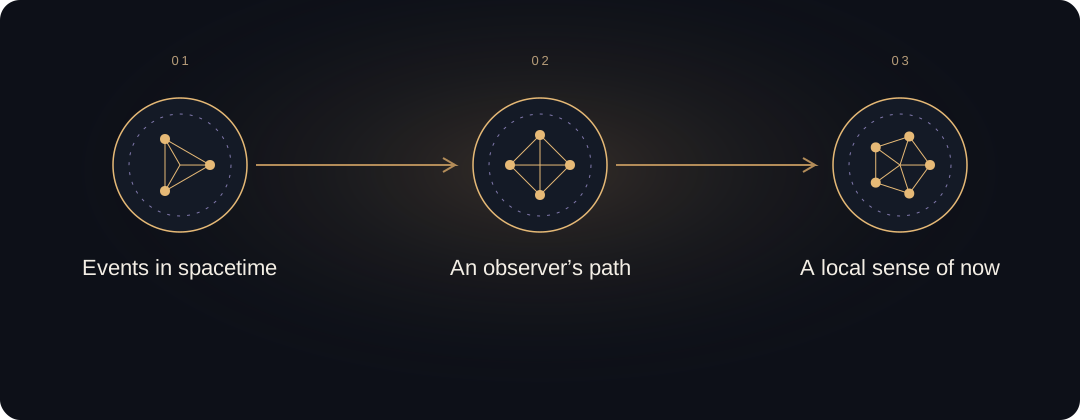
For this theory, that has two main consequences.
First, the human experience of time does not set the standard for every possible intelligence. A slow biological observer, a fast computational agent, and a hypothetical primordial organism could organize experience differently while existing within a common physical history.
Second, an advanced being might have a very different conceptual model of duration, identity, and anticipation. It could plan across intervals that feel inaccessible to us, preserve copies or records across enormous gaps, and regard human lifetimes as short local processes.
This permits a restrained version and an expansive version.
Restrained temporal branch: the intelligence has better prediction, longer memory, faster processing, and greater control over its physical situation. It remains limited to ordinary causal communication.
Expansive temporal branch: the intelligence has access to relationships or routes through spacetime that humans do not presently know how to use. This could connect to the unusual-interior story, but it is an additional conjecture.
A block-universe interpretation does not itself provide access to the future, and faster computation does not itself create time travel. Preserving those distinctions gives the expansive branch a clear place without misattributing it to relativity.
The source discussion also asks whether anything can “change the future.” Within a block interpretation, actions can be parts of the history that constitutes the future; their causal significance does not disappear. The theory should not infer that investigation, choice, or communication is pointless. Human action may matter even if it does not rewrite a completed history from outside.
The most useful temporal idea is therefore decentering: humanity is not entitled to assume that its temporal scale, sense of immediacy, or way of maintaining identity is universal.