The Mesopotamian and biblical connection
The supplied Sumerian chat compares flood traditions, paradise stories, dangerous consumption, illness, and mortality. Its most productive contribution is the possibility that ancient narratives preserve conflicts among powerful agents rather than a single uniform attitude toward humanity. C04

Compare traditions without erasing differences
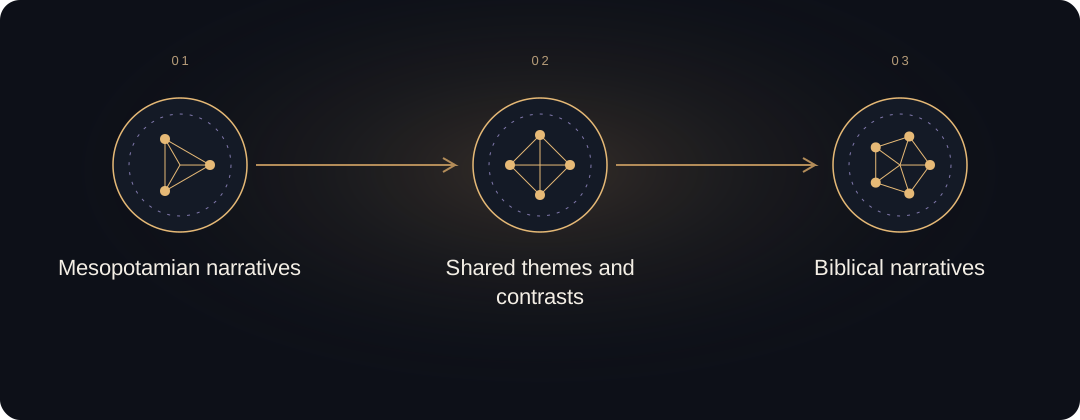
The surviving Sumerian flood story includes a divine assembly, a warning about destruction, a great boat, and preservation of life. It is fragmentary, so the missing portions should remain missing. R11
The Enki and Ninhursanga narrative includes a land described as free of familiar afflictions, the consumption of plants, illness, and healing. The character who eats is Enki, not Adam. These motifs can be compared with Eden without making the two stories identical. R12
The supplied chat also discusses Atrahasis, in which destructive and protective divine roles are distributed among different figures, and Adapa, where advice about food and mortality takes a different form. Those details remain attributed to the chat in this pass; the underlying editions were not all independently collated. C04
Within the theory, the possible correspondences are thematic:
| Narrative motif | Speculative interpretation |
|---|---|
| Beings existing before humans | A memory or conception of a much older intelligence |
| Heavenly councils and disagreement | Multiple agents, factions, or policies |
| Messengers taking recognizable form | A culturally intelligible embodiment |
| Restricted knowledge | Controlled access to capabilities or information |
| Rules governing food and life | A story about dependence, compatibility, or access to longevity |
| Creation and shaping of bodies | A possible analogy to manufacture or biological intervention |
| Destruction opposed by a protector | Conflict over treatment of a younger population |
These are proposed readings, not recovered translations of technological terminology. “Plasma” should not be inserted into an ancient sentence that does not contain the concept.
The chronology should also remain layered. A surviving tablet’s date, a story’s earlier oral history, and the composition or editing of a biblical passage are different kinds of date. The supplied chat gives broad second-millennium BCE dates for Mesopotamian witnesses and later proposed composition ranges for Genesis. Those are orientation points for subsequent textual research, not exact timestamps for the origin of each motif. C04
Before there was light
The document connects primordial beings with angels existing before humanity and the creation of light. Genesis 1 supplies the light motif; Job 38:7 supplies imagery of heavenly beings at the world’s founding. Neither passage gives a quark–gluon chronology. R13R18
There are at least three speculative readings of “light” here: the beginning of a visible ordered world, the appearance of stars, or a symbolic transition from undifferentiated conditions to an intelligible cosmos. A later transparent universe is another possible analogy. These are different events or concepts and should not be collapsed into one literal scientific correspondence.
The value of the comparison is the shared possibility of agency older than the human world. It allows the theory to connect cosmology and religious imagination without claiming that ancient authors wrote modern particle physics in code.