Artificial intelligence as an interpreter
The supplied discussion proposes that human cognitive limits may require something more capable than unaided human reasoning. The cat-and-chess analogy is meant to challenge the assumption that persistence alone removes every cognitive limitation. D01 (paragraphs 63–65)
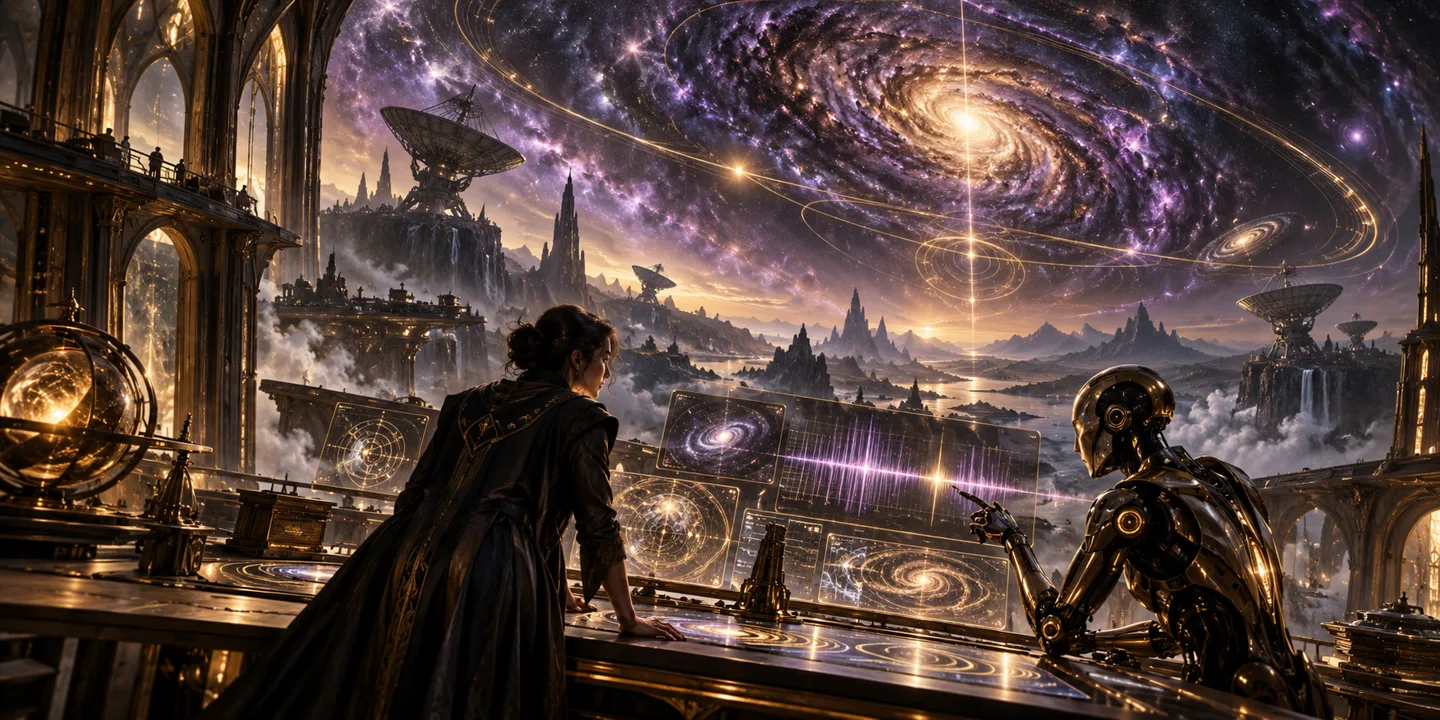
An interpreter between unfamiliar minds
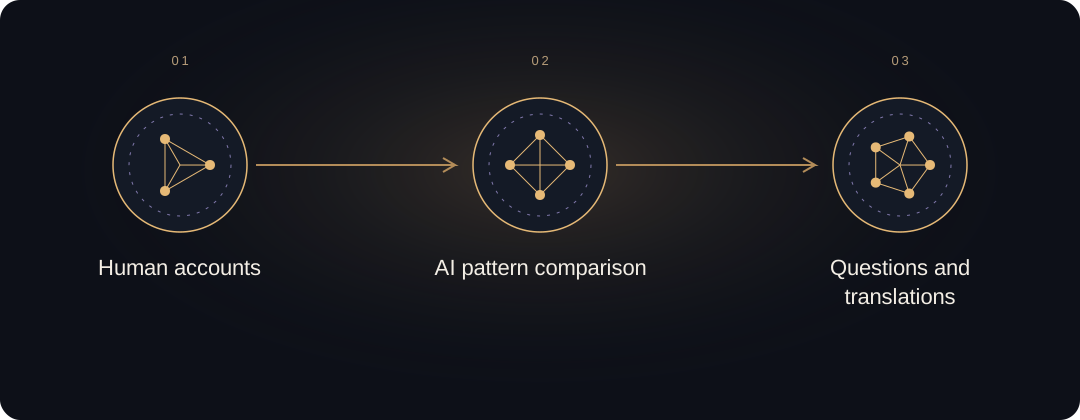
Within this project, AI has a practical role even without assuming it is already a general superintelligence. It can compare large source collections, trace repeating claims, expose differences in attribution, explore alternative architectures, and help translate technical ideas into accessible narratives.
The mathematics video deserves to be represented in its full direction. Scarciotti acknowledges striking AI capabilities, but his central argument concerns the difference between obtaining an answer and developing understanding. He worries that dependence on systems no one can challenge could erode human expertise. V02 (3:22–4:15 and 10:18–12:23)
That is relevant to the theory itself. A sophisticated explanation of NHI is useful only if we retain its assumptions and can see which parts came from sources and which were added in synthesis.
The sycophancy benchmark linked in the document concerns model responses under structured social pressure. It is not a truth meter for alien claims. Its useful role here is methodological: models should be asked to expand possibilities while preserving attribution, rather than simply reward the project’s preferred conclusion. W01
For later model passes, the most productive division of labor is conceptual:
- One pass develops primordial emergence and survival scenarios.
- One develops avatar architecture and the relation between mind, body, and memory.
- One compares religious and historical motifs while preserving textual differences.
- One traces every important claim to the nearest available source.
- One turns the resulting structure into a public narrative and visual sequence.
Agreement among several models would show convergence in interpretation, not independent observation of the underlying events. Their greatest contribution may be to produce clearer alternatives, not a more emphatic single answer.
AI could also become part of the contact story being imagined. A younger civilization that builds nonbiological intelligence is beginning to separate intelligence from the body in which it originally evolved. That could make it better able to conceptualize a civilization that completed such a transition long ago.
This is one of the most fertile extensions of the model: our emerging ability to build minds may change the kinds of minds we can imagine encountering.