A continuous speculative history
The previous chapters describe components. This chapter assembles them into one possible history. Every step involving primordial life or NHI continuity is a hypothesis of this pass.
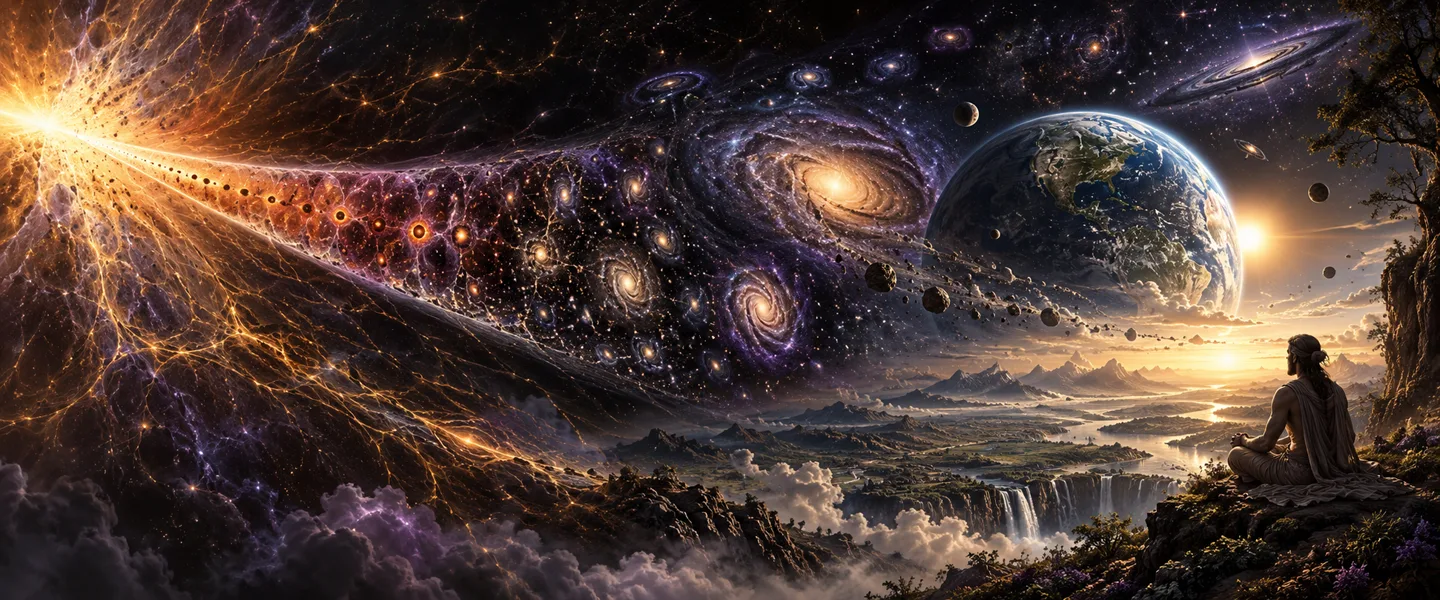
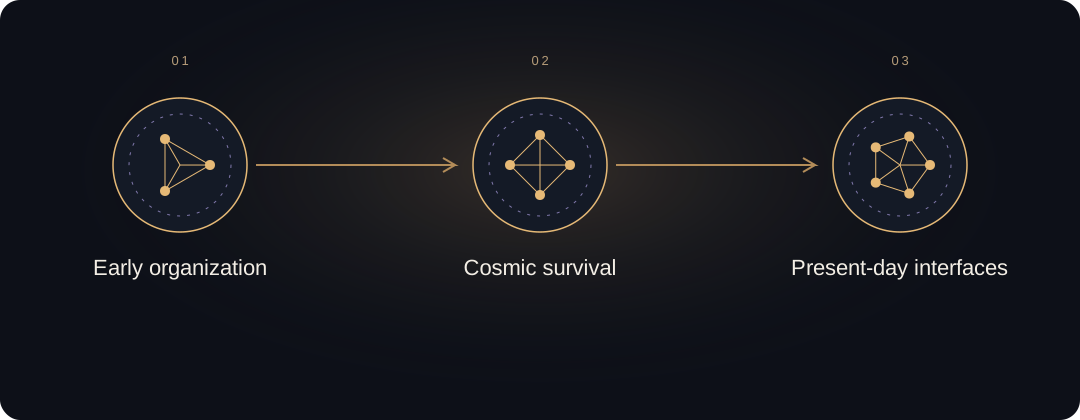
The whole proposed journey
Stage 1 The hot universe
The universe contains rapidly evolving energetic matter. Within that environment, some local organizations persist and reproduce aspects of their structure. Their relevant interactions occur on timescales far shorter than terrestrial biology. Collective modes, wakes, or topological features serve as candidate carriers of state (proposed carriers, not demonstrated primordial mechanisms).
Stage 2 Early information-bearing populations
Some populations acquire richer internal state and more effective control over their surroundings. Their descendants accumulate organization. Eventually, a subset develops intelligence capable of modeling environmental change. In this imagined history, coordinated feedback and inherited variation would have to support development within the available interval.
Stage 3 The first survival crisis
Cooling threatens the conditions on which those systems depend. Adaptation, preservation, or deliberate transfer becomes decisive. Only some lineages continue. The survivors inherit a practical lesson: identity must not remain inseparable from one physical environment. What is preserved may be memories, design knowledge, causal processes, or institutional records.
Stage 4 Expansion into new media
As the universe develops new structures, descendants exploit new opportunities. Different populations adopt different implementations. Dormancy, protected habitats, and distributed agents allow histories to span much longer intervals than any original organism’s active lifespan.
Stage 5 A mature ecology of intelligence
Some lineages become technological and create artificial descendants. They inhabit a variety of environments and develop different relationships to biological life. There is no necessary single government, species, or purpose. Plural origins and shared infrastructure remain possible.
Stage 6 Earth becomes an object of interest
Earth’s evolving biosphere becomes useful, interesting, or simply accessible. Interaction may begin before humans. Local platforms and agents allow contact without exposing distant infrastructure or requiring the original life form to survive directly in terrestrial conditions.
Stage 7 Humans encounter interfaces
Some encounters, within the hypothesis, involve luminous forms; others involve bodies or craft. Human accounts encode the experience through familiar categories. Memory, oral transmission, social authority, and changing theology reshape the stories.
Stage 8 Modern institutions acquire fragments
Military sensors, witnesses, researchers, and alleged recovery efforts produce different types of records. Access becomes fragmented. Some institutions seek technical advantage; others seek explanation; still others resist conclusions they cannot support or control.
Stage 9 Digital civilization becomes observable
Human society creates an immense public archive of its own behavior. A capable observer could use that archive to model cultural responses and refine its interactions. Humanity remains uncertain about the observer while making more of itself legible.
Stage 10 Humans begin building alternative intelligence
Artificial intelligence and biotechnology make the separation of mind, body, memory, and manufacture increasingly thinkable. The same developments that motivate the avatar analogy also give humans tools for studying the source material more systematically.
Stage 11 Contact becomes a question of identity
The most important question changes. Instead of asking only where a visitor’s home planet is, humans begin asking what constitutes the visitor, where its intelligence resides, whether the visible body is an individual, and how much of the encounter has been selected for human comprehension.
This sequence is the proposed cosmological-to-human narrative. Its major connecting idea is continuity of organization across changing embodiments.