Branches of the theory
A complete pass should preserve meaningful alternatives rather than force all material into one immutable story.
A family of possible explanations
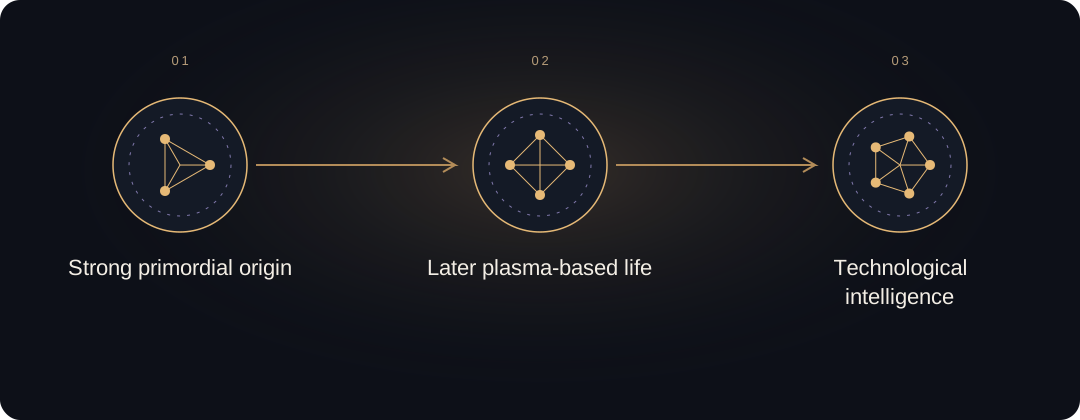
Branch A Primordial descendants
The intelligence originates in the hot early universe and survives through changing media. This is the project’s central and most ambitious version. It gives the beings a history older than stars and makes flexible embodiment a fundamental adaptation.
Branch B Later plasma life
The intelligence originates in a later plasma environment rather than the quark–gluon epoch. This preserves a noncarbon origin while removing the need to cross the earliest cosmic transitions. It could still be vastly older than humanity.
Branch C Biological civilization that outgrew biology
An ordinary biological civilization develops artificial or field-mediated embodiments. Its present forms resemble the proposed system even though its origin was not primordial. This branch is important because present appearance does not uniquely reveal ancestry.
Branch D Many origins and shared infrastructure
Different lineages converge on interchangeable bodies, local manufacture, and distributed intelligence. Similar phenomena need not have a single origin. A “plasma being” could be one member or one device within a heterogeneous civilization.
Branch E Religious identity
The entities are connected to the beings described by a religious tradition, with their physical manifestations participating in a larger theological reality. This branch can intersect with the others, but it adds claims about religious identity that the physical model alone does not establish.
Branch F Mixed reports
The source collection combines hypothetical genuine encounters, ordinary phenomena, errors, fiction, disputed recollections, and culturally related stories. A viable theory of a subset need not explain every item as a manifestation of the same intelligence.
The working narrative is A with D and F retained: a primordial lineage is explored as the central story, while plurality and mixed causes remain possible. B and C are alternatives if the earliest-origin part is later revised. E is a distinct interpretive layer. Multiple lineages and alternative origins make the overall theory more complete by preventing over-fitting of every report to a single origin.