A civilization inside a microsecond
The objection that the primordial interval was brief is central to the supplied discussion. The response is to ask what counts as a long interval for a system whose operations are much faster than ours. C12C13
One interval, different internal clocks
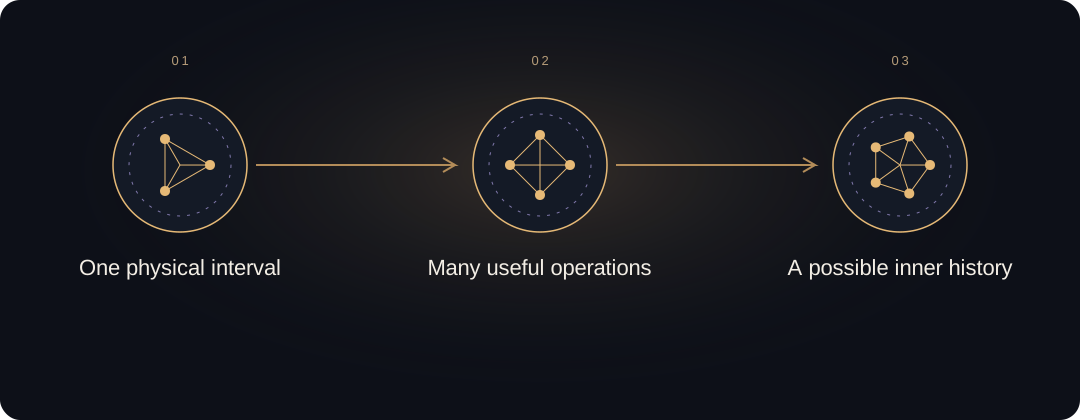
Three different quantities matter:
- Elapsed physical time: the duration measured by a suitable clock.
- Processing opportunity: how many meaningful operations a system can complete during that duration.
- Experienced duration: what, if anything, those operations feel like to a conscious system.
The theory needs an enormous processing opportunity. It does not require us to assume that one interaction automatically equals one thought.
The supplied plasma-time chat uses an illustrative operation time of (10^{-20}) seconds. Over (10^{-6}) seconds, that gives:
[ N = \frac{10^{-6}}{10^{-20}} = 10^{14}. ]
If, solely for comparison, each hypothetical operation corresponded to a human-scale cognitive interval of 0.1 seconds, the sequence would contain the equivalent number of intervals found in approximately 317,000 human years. This is arithmetic under chosen assumptions, not a measurement of plasma consciousness. C12
That distinction leaves an interesting possibility intact. A universe that changes almost instantaneously to us could change gradually relative to its earliest hypothetical inhabitants. They might observe environmental trends, develop models, and face a recognizable future: their medium is changing, and survival requires adaptation.
The fruit-fly comparison serves as a smaller analogy. The linked chat gives a rough visual-processing ratio of three to one, but explicitly distinguishes that from a demonstrated conversion between conscious lifetimes. The useful idea is diversity in temporal resolution, not a universal formula for animal experience. C13
Within the primordial theory, faster operation would have several consequences beyond “more time”:
- Environmental change could become predictable on the organism’s internal scale.
- Many generations might occur within a short cosmological interval.
- Small structures could have large histories relative to their own dynamics.
- Descendants might later adopt slower operation as their available environment changed.
A civilization with that ancestry could regard time as an engineering parameter: sometimes operate rapidly, sometimes pause, sometimes distribute activity across differently paced systems. Human conversation could be an extraordinarily slow interface for it.