Surviving the cooling universe
An early beginning is only the first part of the story. The theory must also imagine a bridge from that early environment to the present. An intelligence that arose and vanished in the first microseconds would be an extraordinary form of life, but would not explain modern encounters.
Three routes across a changing universe
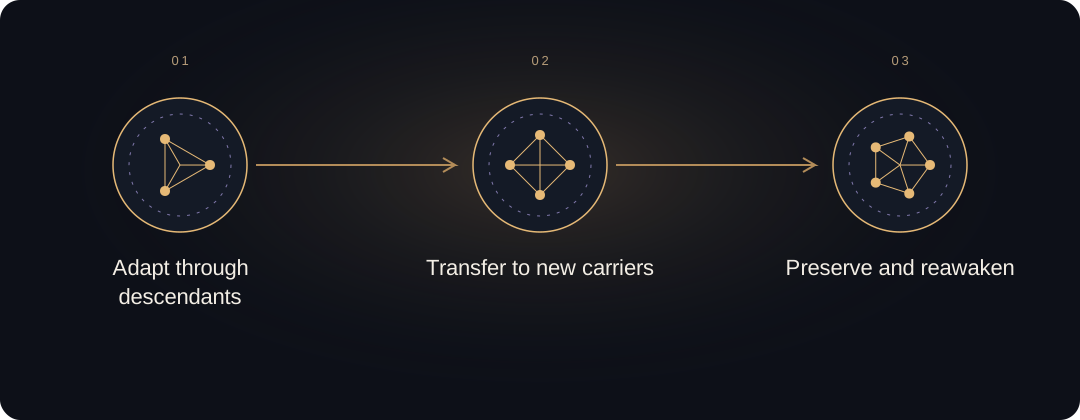
The crucial proposed innovation is preserving organized information while changing the material that carries it.
There are four broad speculative survival routes:
| Route | Proposed continuity | Narrative consequence |
|---|---|---|
| Successive adaptation | Descendants change with their environments | An evolutionary lineage spans multiple kinds of matter |
| Deliberate transfer | Organized agents engineer a new implementation before the old one fails | Migration becomes a defining civilizational capability |
| Protected habitats | Local conditions are maintained despite external change | The intelligence becomes dependent on engineered environments |
| Dormancy and reconstruction | Information persists with little activity and is reactivated later | Long gaps need not represent continuous conscious experience |
These routes can combine. A lineage might first adapt naturally, then develop technology, then preserve some populations in protected habitats while seeding others elsewhere. Much later, those descendants might no longer resemble the original organisms in any physical sense.
For the most ambitious version, cosmic transitions would become the first existential crises. The earliest civilizations would learn that their bodies are temporary solutions to environmental conditions. Survival would select for systems capable of preserving identity, reconstructing damaged organization, and accepting radical changes of embodiment.
This creates a coherent reason for the later avatar architecture. An intelligence that survived by repeatedly changing bodies would not regard a single body as the natural boundary of the self. A manufactured organism on Earth would be one more local adaptation in a much older history of adaptation.
The transfer mechanism remains unspecified in this version. That is a genuine open chapter, not a reason to insert “quantum” or “another dimension” as a substitute for an explanation. A subsequent model pass can explore several concrete fictional or theoretical mechanisms while preserving their status as proposals.
What is carried forward?
The second pass makes a useful distinction between five possible inheritances: personal memories and dispositions; goals and design knowledge; an uninterrupted causal process; cultural records and institutions; or only a lineage of related designs. A civilization could preserve some of these while losing others.
The principal narrative here combines early adaptation with later deliberate transfer. Dormancy and protected habitats remain possible supporting routes. This is a choice about how to tell the theory, not a finding that selects one actual cosmic history.
The link to avatars then becomes causal: descendants whose survival depended on changing their physical implementation would already possess a tradition of separating enduring organization from temporary bodies. Local biological manufacture would be a later application of that ability, not an unrelated technology introduced solely to explain human-like occupants.