From primordial organisms to cosmic civilization
Even if a primordial lineage survived, it need not have become one unified, omnipotent civilization. The universe is enormous, and the theory becomes more interesting when its inhabitants have histories, constraints, and differences.
An ecology, not a single empire
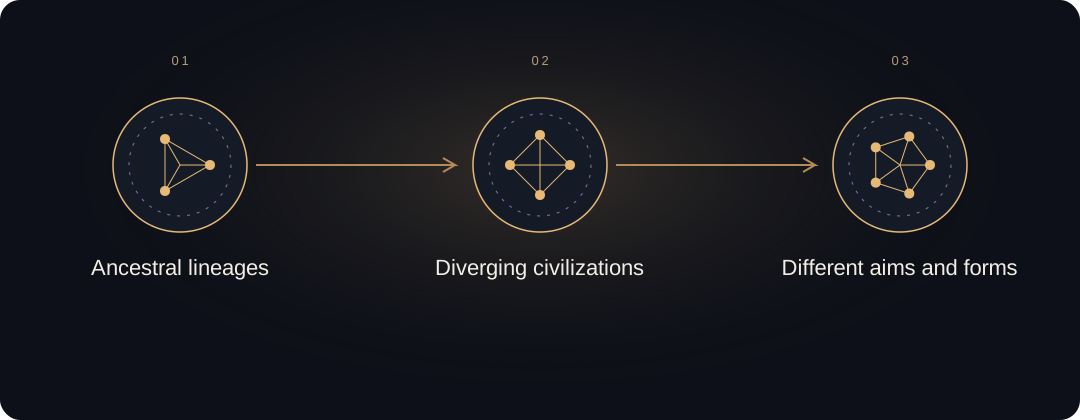
Imagine many surviving populations. Their environments diverge. Some specialize in dense energetic habitats; others use increasingly durable machinery; still others become distributed information systems. Some preserve individual continuity, while others reproduce through branching, merging, and collective inheritance.
This produces a possible ecology of ancient intelligences, rather than a single species with a single policy toward humanity.
Such an ecology could contain:
- Long-lived lineages that maintain continuity with their ancestral organization.
- Descendants reconstructed from stored records.
- Artificial agents created by earlier life.
- Civilizations that combine biological, computational, and field-mediated systems.
- Splinter groups with different aims and rules of interaction.
The advanced agents encountered near Earth, if any, might occupy a minor position in that ecology. A local craft could be a routine instrument rather than the flagship of a cosmic empire. An apparent messenger might be an employee, a delegated system, or a limited process whose creators are themselves subordinate to something older.
This helps reconcile impressive capabilities with apparently fallible behavior. A very old civilization can produce disposable, specialized tools. Its tools need not exhibit everything the civilization knows. The loss of a local device would not establish that its designers are careless in every domain.
Nor does great age guarantee uninterrupted progress. There could be collapses, dormant periods, lost technologies, migrations, conflicts, and changes in objectives. “Billions of years old” should describe a possible depth of history, not a mathematical promise of infinite capability.
The relation to Earth could also predate humanity. In the first NewsNation compilation, Loeb discusses the possibility that hypothetical visitors were present before humans. That does not establish primordial ancestry, but it supports considering a timeline much longer than modern sightings. V01 (24:23–25:08)