The relationship between intelligence and its body
Human beings normally experience a close coupling of personal identity and biological body. That coupling shapes our expectations. We imagine a visitor as someone born on another planet, who enters a vehicle, crosses space, lands, and walks out.

Separate the mind from its interface
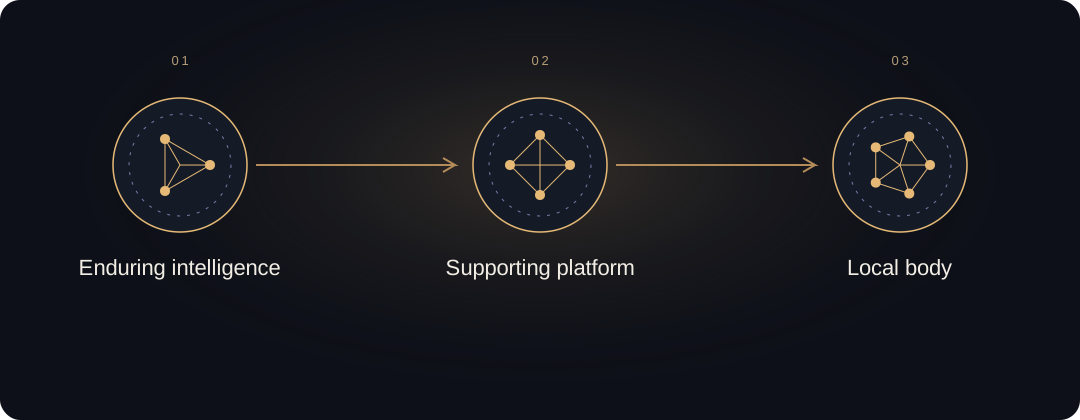
The avatar chats suggest another architecture. The intelligence remains elsewhere while local bodies act for it. C05C07
This first pass distinguishes five levels:
| Level | Function | What a human might encounter |
|---|---|---|
| Source intelligence | Long-term identity, objectives, and accumulated knowledge | Possibly never directly accessible |
| Distributed infrastructure | Storage, communication, manufacture, and coordination | A hidden or distant operational network |
| Local platform | Environmental control and deployment | A craft, installation, or mobile device |
| Agent | Sensing, action, limited decisions | A biological occupant, robot, or orb |
| Presentation | The interface actually perceived | A humanoid appearance, luminous object, voice, or image |
The levels need not be physically separate. An orb could combine platform and agent. A body could contain a full independent person. A craft could itself be the agent. The table describes roles, not a mandatory anatomy.
It also exposes three distinct meanings of “avatar”:
Remote embodiment. A distant individual operates through a local body. Communication quality matters, and interruption may leave the body unable to function normally.
Autonomous delegate. A local agent has its own decision-making ability and only a subset of the source intelligence’s knowledge. It can operate without continuous contact.
Instantiated person. A new individual is created from a template or partial copy. It may have genuine experiences, interests, and moral standing even if manufactured for a task.
Those distinctions matter. A biological agent is not necessarily an empty puppet. An intelligence that creates living interfaces may also create new subjects of experience. The resulting ethical questions belong inside the theory, particularly when the theory later considers captured beings and expendability.