Orbs and plasma manifestations
The plasma connection in the source videos is more specific than a general claim that all aliens are made of plasma. At approximately 21:31 in the first NewsNation compilation, Luis Elizondo discusses speculation that some orbs display behavior associated with intelligence or a life form. In the other compilation, Jeremy Corbell discusses plasmoid-looking objects, reported effects on people, and the possibility of scouts or a visible aspect of something larger. V01 (21:31–22:18) and V03 (2:48–3:26 and 6:05–7:06)
One appearance, several explanations
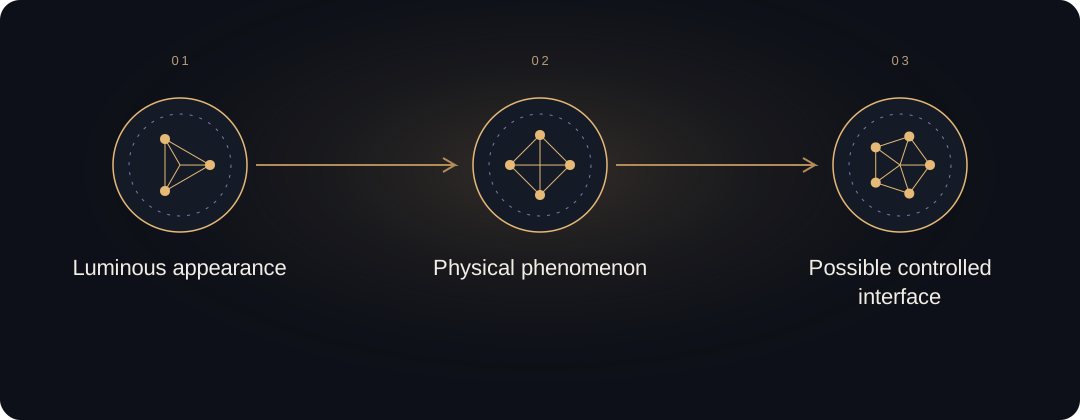
This supplies several branches for the theory:
The organism branch
The orb is a localized living embodiment. Its structure both sustains the agent and mediates its interaction with the environment. Movement, changes of shape, and changes of brightness could be physiological activity rather than ordinary mechanical flight.
Under this branch, a luminous encounter could be direct contact with an unfamiliar kind of organism. A later biological body would be a separate adaptation for tasks the luminous form cannot readily perform.
The probe branch
The orb is manufactured. Its apparent responsiveness reflects control software or a remote operator. The source intelligence need not be plasma-based at all, even though the primordial version of the theory permits that ancestry.
This is analogous to recognizing an aircraft as active without mistaking the aircraft for the organism that designed it. The crucial distinction is between an object that behaves intelligently and an object that constitutes a conscious being.
The interface branch
The orb is the locally visible boundary of a larger system. It may be an illuminated envelope, a projected sensory interface, or a visible interaction region. Human observers encounter the presentation layer while the operational structure remains elsewhere or otherwise unrecognized.
This branch provides a conceptual connection to apparently changing sizes or forms. If the observed surface is an interface rather than a rigid body, its appearance need not reveal the full geometry or location of the system.
The unrelated-phenomena branch
Some luminous objects could be ordinary or unfamiliar natural phenomena while others, in the hypothesis, are artificial. A broad category such as “orb” need not have a single cause. Preserving this branch prevents the theory from demanding that every light in the sky belong to one cosmic lineage.
The primordial-origin theory is strongest as an account of a possible subset, with a clear distinction between ancestral substrate and present manifestation.