Human secrecy and partial disclosure
The source material proposes that secrecy could have deeper causes than ordinary military classification. The theory can accommodate that while keeping human incentives and hypothetical NHI incentives distinct.
Information becomes fragmented
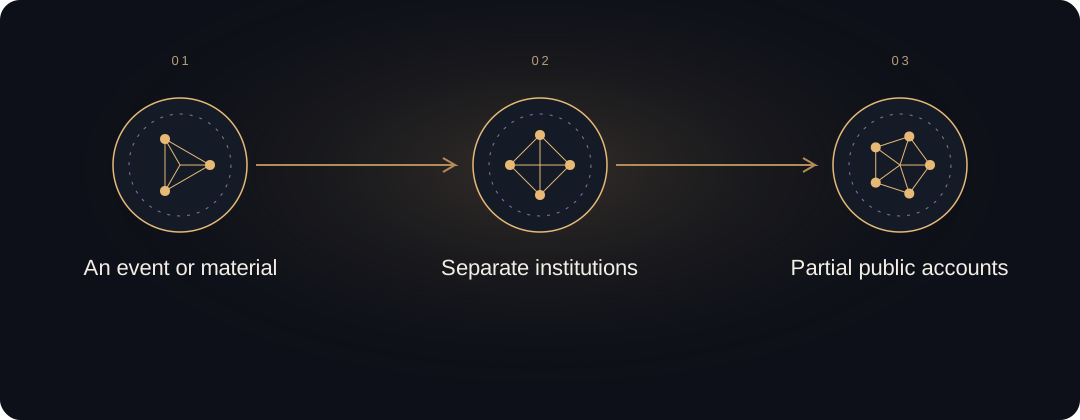
There are at least five possible layers:
- Operational secrecy: protecting sensors, sources, locations, and intelligence methods.
- Competitive secrecy: preventing other states or organizations from exploiting useful technology.
- Institutional secrecy: protecting authority, reputations, prior decisions, and control over access.
- Interpretive uncertainty: withholding conclusions because the material is not understood or institutions disagree about it.
- Counterpart-related secrecy: fear of consequences, arrangements with a nonhuman actor, or uncertainty about its response.
The first four can operate without the fifth. The fifth is the additional speculative layer developed by this theory.
The NewsNation material explicitly raises compartmentalization, private industry, political limits, and societal or religious disruption. Stratton describes an alleged legacy program and a competitive effort to recover and reverse-engineer craft. Ron James argues that the political process will not reveal the entire picture. These are their claims and interpretations. V03 (17:01–18:01 and 25:43–28:28)
The theory’s most consequential secrecy scenario is not simply that authorities possess a working flying saucer. It is that some possess fragments of contact without control over the wider situation. A body may be temporary; a craft may be unusable without infrastructure; a witness may understand only a small compartment. Disclosure would then expose a mixture of extraordinary possibilities and substantial ignorance.
This could help explain contradictory statements within the hypothetical. “Government” is not a single observer with one memory. Different offices may have different records, access, responsibilities, and beliefs. A private contractor, a military office, an elected official, and a witness could each hold different pieces.
Yet this architecture does not establish any specific secret arrangement. The theory proposes ways secrecy could arise; it does not invent a treaty, a hidden command structure, or named participants beyond what sources actually allege.
The Mark Twain clip adds a symbolic version of the disclosure problem: discovering an intelligence whose power is immense but whose concern for human lives is uncertain. That is an emotional and philosophical analogy, not documentary evidence about government motives. V04