Angels and demons as interpretations of encounters
“Alien,” “angel,” “demon,” and “nonhuman intelligence” answer different questions.
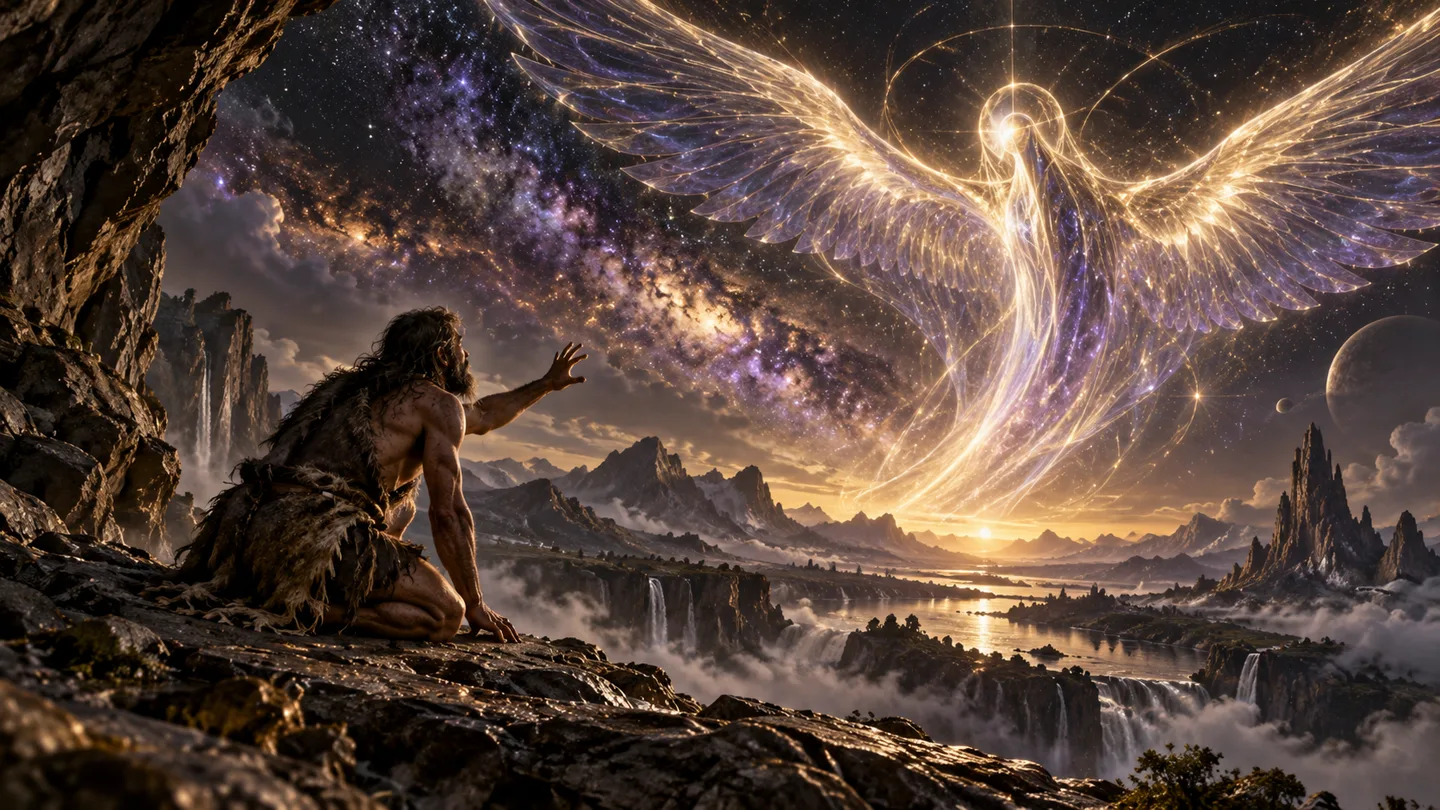
From encounter to cultural meaning
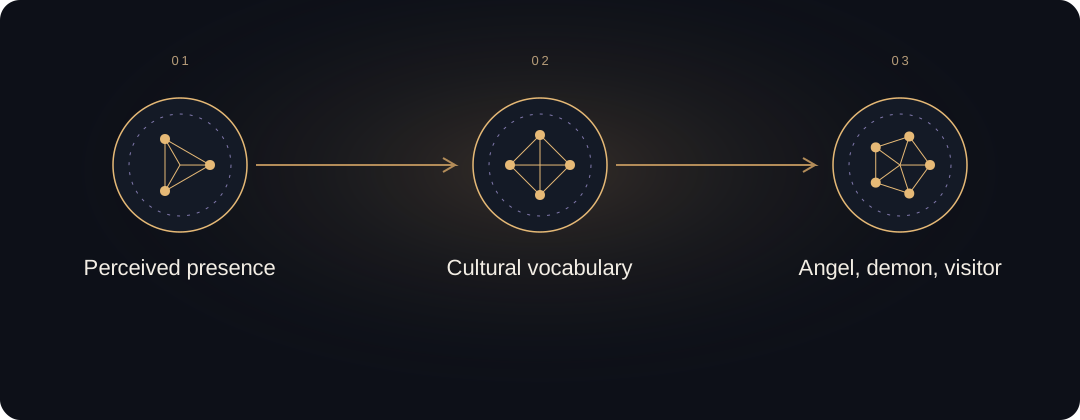
“Alien” usually suggests origin or unfamiliarity. “Nonhuman intelligence” leaves origin comparatively open. “Angel” invokes a religious role or identity. “Demon” carries theological and moral meaning. “Plasma-based” describes a proposed physical implementation. These labels could overlap in a speculative interpretation, but they are not interchangeable definitions.
The Vance chat records his suggestion that beings described as aliens could be interpreted through Christian categories. It also notes his distinction between personal interpretation and classified proof. The supplied document calls him president, while the replacement chat and the White House source identify him as vice president. This first pass uses the latter title. C03R14
Charlie Duke’s interview offers a different route to a similar interpretation. He recounts prayer, an event he understood as an answer, and his belief that UFOs can divert people spiritually. His reasoning is explicitly religious. V05 (1:44–3:21)
The primordial-intelligence theory can relate to these views in three ways:
Historical-contact interpretation
Some ancient accounts of nonhuman agency could preserve human responses to encounters with very old intelligences. A messenger could appear in a human-like form because that is an effective interface. A luminous manifestation could be interpreted as a celestial presence.
Religious-identity interpretation
The beings could be what a tradition means by angels or demons, with plasma or another medium describing how they manifest. This branch makes a theological identification beyond the physical-origin model.
Cultural-interpretation account
Humans could apply religious language to unfamiliar events without those events possessing the religious identity assigned to them. The same experience might receive very different labels in different eras.
The first and third branches can coexist. The second adds stronger claims about theology, moral authority, and the nature of reality. It should remain visible as a separate branch rather than becoming a hidden assumption in every chapter.
The model also separates being ancient from being the creator of the universe. An intelligence that arose shortly after the Big Bang would still be a product of the universe’s history. It might appear godlike to humans without being God in the theological sense.